


7 California Dealer Background Check Steps to Know

Last Updated: October 30, 2026
Quick Summary
Most people who own or control a California dealership must pass a dealer background check, which the DMV uses to confirm who is behind the business before issuing a license. This generally covers owners, officers, and other responsible parties, and it is completed through fingerprinting at an approved Live Scan site. Applicants must also disclose criminal history honestly on the application.
Owners, officers, partners, and other responsible parties usually must complete the dealer background check.
Fingerprints are captured digitally through an approved Live Scan site, not with ink cards.
Your valid photo ID name must exactly match the name on your dealer application.
Keep your Live Scan request form receipt as proof of completion.
The DMV reviews convictions case by case, so full disclosure is essential.
Table of Contents
Who Must Pass a Background Check for a California Dealer License
If you want to run a vehicle dealership in California, you will likely need to pass a dealer background check. The California DMV reviews applicants as part of the licensing process (Vehicle Dealer License).
We know the process can feel confusing, especially when English is your second language. Our team is here to explain each requirement in plain terms.
A dealer background check generally applies to the people involved in the business, not only the applicant on paper. Owners, officers, and others with a major role may each have to complete the check.
Who is usually included:
The main applicant or business owner
Officers or partners who are part of the business
Anyone the DMV identifies as a responsible party
California Dealer License Fingerprint Requirements and Live Scan
Live Scan is the electronic fingerprinting system used for dealer-license applicants in California. Instead of ink cards, your prints are captured digitally and transmitted to the California Department of Justice (DOJ), which forwards results to the DMV. Understanding who must be printed, what to bring, and how results travel is the difference between a clean submission and a months-long delay.
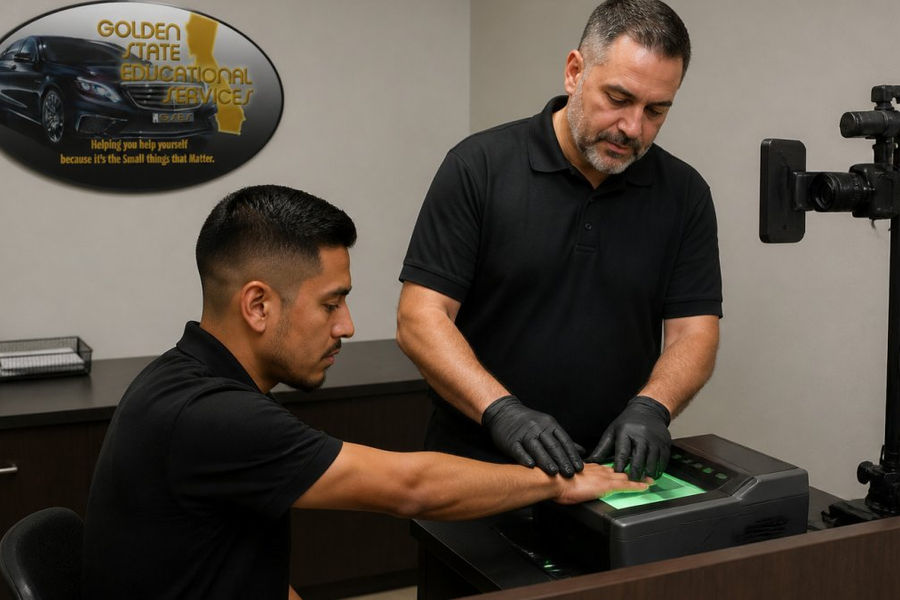
Who has to be fingerprinted
Fingerprinting is not limited to the person whose name is on the application. The DMV generally requires prints from the people who own or control the business, which commonly includes:
The sole owner or each general partner
Corporate officers, directors, and shareholders with a significant ownership interest
Any individual the DMV identifies as a responsible party for the dealership
Because the exact list depends on your business structure (sole proprietorship, partnership, LLC, or corporation), confirm the responsible parties for your entity type with the DMV before you book appointments. Printing the wrong people, or missing one, is one of the most common reasons a dealer application stalls.
The Live Scan workflow, step by step
Get the correct request form. The DMV provides the fingerprint request instructions with your application packet. The form lists the submitting agency and the billing number the technician will enter, so the results route to the right file. Do not use a form from a different agency or an old packet.
Book an approved Live Scan site. Sites include many police and sheriff stations, private fingerprinting businesses, and some mail-and-ship stores. Availability and wait times vary widely by region, so call ahead or check the DOJ's list of approved Live Scan providers.
Bring the right identification. You need a valid government-issued photo ID, typically a driver's license, state ID, passport, or permanent resident card. The name on your ID must match the name on your application exactly. A middle name, suffix, or maiden name that does not match is a frequent cause of rejected prints.
Complete the transaction at the site. The technician scans your prints, collects the applicable processing fees, and gives you a completed request form with a transaction number.
Keep your receipt. The stamped or printed copy of your request form is your proof of completion. Keep the original and a photo of it with your application file.
If your name has changed, bring the document that bridges the names, a marriage certificate, court order, or updated ID. The technician cannot fix a name mismatch at the counter.
How results reach the DMV
Your prints are submitted electronically through the state process, and results are returned to the requesting agency. That means you will not receive a copy of your own background report from this process, and the Live Scan site cannot tell you what the report says. If the DMV needs clarification, it will contact you directly.
What to do if your Live Scan is delayed or rejected
Delays usually fall into three buckets:
Rejected prints. The technician may flag prints as unreadable, often because of dry skin, calluses, or lotion. You will be asked to reprint, usually at no additional state fee within a set window. Reprint promptly.
Name mismatch. If the name on your prints does not match your application, the DMV may treat the check as incomplete. Correct the record with the DMV in writing and be prepared to reprint.
Processing backlog. State and federal checks can take days to weeks depending on volume. If your application is otherwise complete and you have not heard back, contact the DMV's occupational licensing unit, reference your transaction number, and ask whether the fingerprint results have posted.
Do not submit a second Live Scan at a different site to "speed things up." Duplicate submissions can create conflicting records and slow the review. One transaction, tracked to completion, is the safer path.
A note for family-run dealerships
When a spouse, son, daughter, or sibling is an owner or officer, that person is generally a responsible party and must be printed too. Plan the appointments together so the whole family's checks move through the system at the same time, it avoids one relative's results lagging behind and holding up the license.
The table below lists the main Live Scan steps so you can check them off in order.
Step | What to do | Note |
Get the correct request form | Use the form in your DMV application packet | Do not use an old or different agency's form |
Book an approved Live Scan site | Call ahead or check the DOJ provider list | Wait times vary by region |
Bring valid photo ID | Driver's license, state ID, passport, or green card | Name must match your application exactly |
Complete the transaction | Technician scans prints and collects fees | You receive a transaction number |
Keep your receipt | Store the original and a photo of it | This is your proof of completion |
How to Complete the Dealer Application and Disclose Convictions
Your application asks you to answer questions about your criminal history. Answer every question honestly. Leaving out a conviction can cause more problems than the conviction itself.
Disclosure rules can depend on the type of record and how long ago it happened. Read each question carefully before you answer it.
Golden State Educational Services can help you organize your DMV application paperwork.
Can You Get a California Dealer License with a Felony?
A felony does not automatically block you from getting a dealer license. The DMV reviews each application based on its own facts. The type of offense, when it happened, and what you have done since can all matter.
Because every case is different, the best next step is to disclose your history fully and seek guidance on your situation. Proactive transparency regarding your own background often mirrors the diligence required when checking vehicle history to ensure compliance and peace of mind throughout the dealership process.
How a Criminal Record Is Reviewed During Your Application
The DMV reviews each application individually rather than applying a simple pass/fail screen. For more on dealership compliance and DMV records, you can review our practical guide. That framing matters: a conviction that would disqualify someone from, say, a job handling cash directly may be weighed differently for a dealership owner who supervises others. The review is fact-specific, and the outcome depends on how you present your history.
The factors reviewers typically weigh
Reviewers commonly weigh the following considerations:
The nature and gravity of the offense. Crimes involving fraud, theft, forgery, or vehicle title and odometer violations draw closer scrutiny because they touch the core duties of a dealer. Offenses unrelated to the business carry less weight.
How recent the conduct was. Older convictions, especially those followed by years of clean conduct, are generally viewed more favorably than recent ones.
The relationship between the offense and the license. Reviewers ask whether the conduct suggests a risk of repeating harm in a dealership setting, for example, misleading customers about a vehicle's history or condition.
Disclosure versus automatic disqualification
There is an important distinction between a conviction that must be disclosed and a conviction that automatically bars licensure. Applicants should disclose convictions as the application requires, and the DMV evaluates them case by case. The DMV evaluates each conviction on its own facts, and applicants should consult the DMV's current guidance on how specific offenses are weighed. The practical takeaway: disclose fully and accurately, then build the strongest possible record around the circumstances.
A complete, honest disclosure with rehabilitation evidence is almost always stronger than a sparse application that leaves the DMV to fill in gaps from a database.
How to present rehabilitation evidence
Gather documents before you submit, not after a request arrives:
Certified copies of court dispositions for each case
Proof of completion of probation, parole, or diversion programs
Restitution payment records
Keep the statement factual and brief.
Reviewing and correcting your own record
Before you apply, request your own criminal-history summary from the California DOJ using the agency's applicant request process. Review it for errors, wrong disposition, charges listed as convictions, cases that belong to someone with a similar name. If something is inaccurate, follow the DOJ's correction procedure and keep copies of your correspondence. Correcting the record before the DMV sees it prevents a denial based on information that was never true.
If the DMV raises a concern or denies the application
An adverse finding is not always the end of the road. Applicants should review any denial notice carefully and consult the DMV's guidance on responding. Deadlines in these notices are short, so read the notice the day it arrives, calendar the response date, and consider consulting an attorney who handles California licensing appeals. For applicants whose English is a second language, having a trusted advisor walk through the notice line by line can prevent a missed deadline.
Never let a denial notice sit. The appeal window is limited, and missing it can close off options that would otherwise have been available.
What this means for your application strategy
Build the background-check portion of your application as if you will need to explain it, because a meaningful share of applicants do. Complete disclosure, organized documentation, and a prompt response to any DMV request are the three levers you control. Handle them well, and the review becomes a process to manage rather than a wall to hit.
Checking Your California Dealer License Application Status
After you submit your application and fingerprints, track your progress through the DMV. Keep copies of everything you send. If the DMV asks for more information, respond quickly to avoid delays.
If your application is held up, call the DMV and ask what is still needed. Write down the date, the name of the person you spoke with, and what they told you.
Booking Your Next Step Toward Your Dealer License
Clearing the background check is one important step, but it is only part of the process. You can learn California dealer license requirements and review the enrollment options for our DMV-approved pre-license dealer education.
If you want hands-on help with your application, you can get help with your DMV salesperson license application.
Ready to talk through your situation? Start a one-on-one inquiry with Golden State Educational Services and get a clear plan for your dealer license. Contact us today.
Frequently Asked Questions
Does California require a background check for a vehicle dealer license?
Yes. California requires applicants for a vehicle dealer license to undergo a criminal background check as part of the Department of Motor Vehicles review. Applicants generally submit fingerprints through a Live Scan location and request clearance. The DMV considers the results along with the disclosures made on the application. Because requirements can change, check the California DMV's Vehicle Dealer License page for the current process before you apply.
Do all owners and officers need a background check for a California dealer license?
The answer depends on how the business is structured and which individuals hold ownership or responsible roles. Applicants should review the DMV's current dealer-license guidance to confirm which persons must submit fingerprints and disclosures for their specific entity and license type. Golden State Educational Services can help you organize the paperwork for your business structure, and you can contact the office for a review of your situation.
Can a dealer license application be denied because of a criminal record?
A criminal record does not automatically disqualify an applicant. Applications are generally reviewed on an individual basis. Applicants who disclose convictions honestly and provide accurate documentation are in a stronger position than those who omit information. If you have a conviction, review the DMV's guidance on felony and misdemeanor disclosure before you submit your application.
How can you check the status of a California dealer license application?
Applicants can contact the California DMV's occupational licensing office to ask about the status of a pending dealer license application. Keep your application number and the date you submitted your paperwork ready when you call or write. Delays often come from missing documents, incomplete disclosures, or fingerprint results that need follow-up, so confirm that every item on your checklist was received.
Comments